
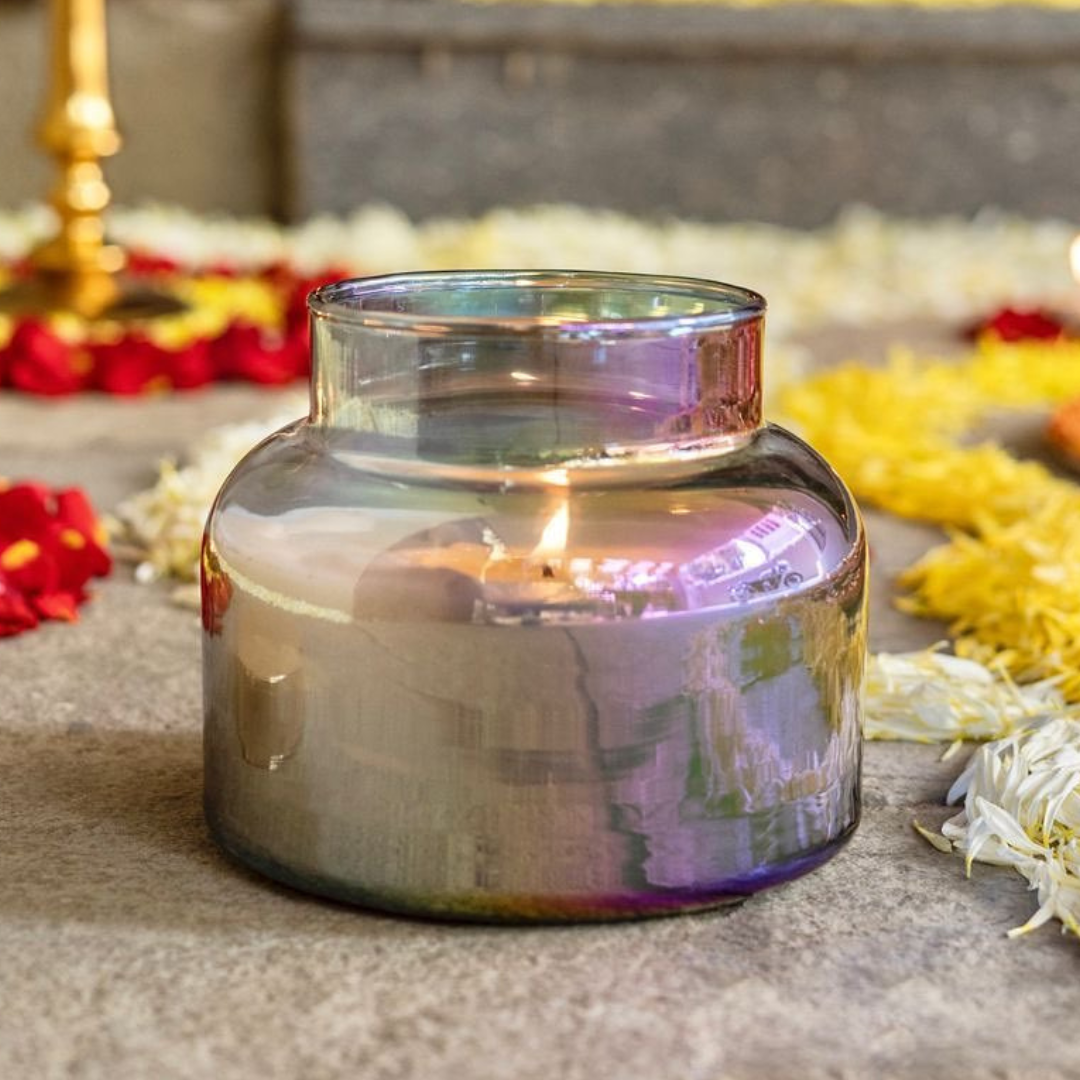
Something magical happens when you light a candle in a metallic vessel.
The room gets brighter, warmer, and perhaps more alive.
This isn't imagination or clever marketing, but fundamental physics and brain chemistry that’s working behind the scenes.
What Happens When Flame Meets Metal
1. The Bounce Effect
Most candles sit in containers that absorb light, such as ceramic, plain glass, or matte finishes.
These materials drink up more light than they give back. Metallic glass candles, however, work backwards: their surfaces grab light and throw it everywhere.
Consequently, one flame suddenly becomes dozens of tiny light sources bouncing off walls, ceilings, and tabletops.
Here's the breakdown:
● Smooth metal creates mirror-like reflections at sharp angles.
● Textured surfaces scatter light in softer, wider patterns.
● Gold, silver, and copper tones shift the color of the light itself.
A single shiny candle can outperform three regular ones simply because of how much light gets recycled through reflection.
2. Movement Catches the Eye
Candle flames never hold still; they sway with the smallest air current.
On a reflective surface, that tiny movement spreads across the whole room, causing shadows to shift and light patterns to dance on the walls.
Human eyes automatically track movement; it’s a hardwired survival instinct.
Yet, flickering candlelight on metal does the opposite of triggering stress. The movement is just interesting enough to hold attention without demanding it, similar to watching waves or leaves rustling in the wind.
Why Shimmer Changes How You Feel
Light Flips Biological Switches
Eyes do more than just see. They feed information to parts of the brain that control hormones and mood. The color of light, its brightness, and whether it moves or stays still all trigger different biological responses.
Premium metallic candles activate several responses at once.
Warm metals push light toward orange and red tones. These wavelengths signal safety to the oldest parts of the brain. They are sunset colors and firelight, the kind of light that historically meant predators were settling down, and it was safe to rest.
Shiny things have also signaled wealth for thousands of years; polished metal required skill to make and indicated resources and care.
Modern brains still read reflective surfaces this way. A room with metallic accents feels more cared for, more abundant, and the mood lifts without conscious thought.
Furthermore, humans evolved around fire. For hundreds of thousands of years, flames were light, heat, safety, and community.
Firelight flickering between 1 and 5 times per second triggers oxytocin release and lowers stress hormones. Metal vessels spread this flicker across more of your visual field, making the calming effect stronger.
Where You Put Them Changes Everything
1. Smart Placement Multiplies Impact
Drop a candle anywhere and it gives off light.
Put it in the right spot and it transforms the whole space. Corners are the best in this regard.
Two walls meeting create natural amplifiers; light bounces back and forth, pushing into areas that usually stay dim.
One candle in a corner can light up zones that would normally need two or three sources.
Near mirrors work well too, but avoid placing them directly facing the glass, as that creates glare. Angle them so reflections multiply without blinding anyone who walks by.
If you stack them at different heights, the light beams cross through space, building layers.
The Anagha Iridescent Shot Glass Candle - Pack of 3 handles this perfectly.
Spread them across a shelf or mantel at varying levels; the iridescent glass catches light from every angle while lotus fragrance fills the air.
Together or Apart?
Grouping several shiny candles creates a focal point. Three to five clustered together pull the eye and anchor a room, which works great on dining tables or mantels.
The Anagha Iridescent Jar Candle makes a strong centerpiece for this kind of setup, as it is
large enough to command attention, with an iridescent finish that radiates in all directions.
Light gets distributed more evenly, making rooms feel bigger and more open.
This technique works better for bedrooms or living spaces with different activity zones that all need some glow.
Pretty Surfaces That Actually Work
1. Beyond Looks
Metal coatings do real work. They change how heat behaves. Instead of escaping through the glass, some thermal energy bounces back into the wax, which creates more even melting and
results in less waste stuck to the sides when the candle burns down. Reflective surfaces also stay cooler than dark ones.
A black ceramic vessel soaks up heat, while a metallic one reflects it. Touch both after burning for an hour, and the difference is obvious. This makes premium metallic candles safer around curious hands and paws.
The Birthday Mercury Effect Votive Candle shows this in action. That shimmering gold jar
stays comfortable to touch even after hours of burning.
The mercury finish does double duty, catching light while managing heat, plus the vanilla scent fills the room without overwhelming it.
2. Quality That Lasts
Cheap metallic paint flakes off after a few uses. Real quality uses vacuum metallization or
electroplating.
These processes bond metal to glass at a molecular level, meaning heat won't strip it and
handling won't scratch it away. The vessels keep working after the wax runs out, too.
The Cupid & Psyche Iridescent Glass Candle proves this point. Burn through the
rose-scented wax, then use that gorgeous iridescent jar for jewelry, hair ties, or spare change. Whatever needs a pretty home.
The shimmer keeps doing its job long after the last flame.
Different Moments Need Different Metals
1. Picking the Right Tone
Celebrations call for specific looks. Traditional events pair well with warm metallics and familiar scents.
The Gold 2-Wick Scented Candle nails this combination, offering hand-poured lotus fragrance in a repurposed golden container.
Visual warmth meets fresh floral notes. Two wicks create a wider pool of melted wax.
More surface area means stronger fragrance throw and a bigger zone of reflected light, which makes double-wick designs better for larger rooms or when you want scent and shimmer to fill the whole space.
What Makes Quality Different
Not every metallic candle delivers what has been described here. The coating method matters.
Glass clarity matters. Wax formula matters. All three determine whether light actually transforms or just bounces around doing nothing special.
Maeva focuses on getting these details right: coatings are applied precisely to maximize
reflection without glare; crystal-clear glass doesn't distort or dull light; and wax blends burn clean at the right temperature.
That wax part is bigger than it sounds. Poor formulas burn unevenly, leaving dark residue on the inside of the vessel. That residue blocks reflection, and the shimmer dies halfway through the candle's life.
A proper blend of palm and paraffin stays clear from first light to last, keeping those reflective surfaces active. The metal lids that come with larger pieces aren't just for show. They keep dust out when the candle sits unused.
They preserve fragrance between burns. But here's a trick: place the lid nearby while the candle burns. It becomes another reflective surface, catching and throwing even more light.
Building Glow Into Your Space
Once you understand what metallic glass candles actually do, using them becomes strategic instead of decorative.
Watch how natural light moves through your rooms during the day. Which corners stay
shadowy? Which surfaces could bounce light if given the chance? Drop metallic candles into those gaps.
Start with one strong piece or scatter several smaller ones. Move them around. Notice how flame and reflection interact with your furniture, wall colors, and existing decor. Keep adjusting until something clicks.
Modern life throws harsh overhead lights and constant screen glare at us nonstop. Reflective candlelight offers relief.
That soft, moving glow signals to the body and brain that the day's demands are winding down.
It's time to breathe; time to exist in a space that feels intentional rather than just functional.
The shimmer isn't decoration. It’s physics meeting psychology, turning a simple flame into
something that genuinely shifts how a space feels and how people feel in it.